The CBMA excise-tax benefit dies at the producer, not the importer
A US importer cannot claim the reduced CBMA excise rate on its own. The foreign producer has to register with TTB and assign the benefit in myTTB — and if it never does, the importer pays the full rate with no way to fix it from this side of the ocean. What to ask for, and the deadline most people miss.
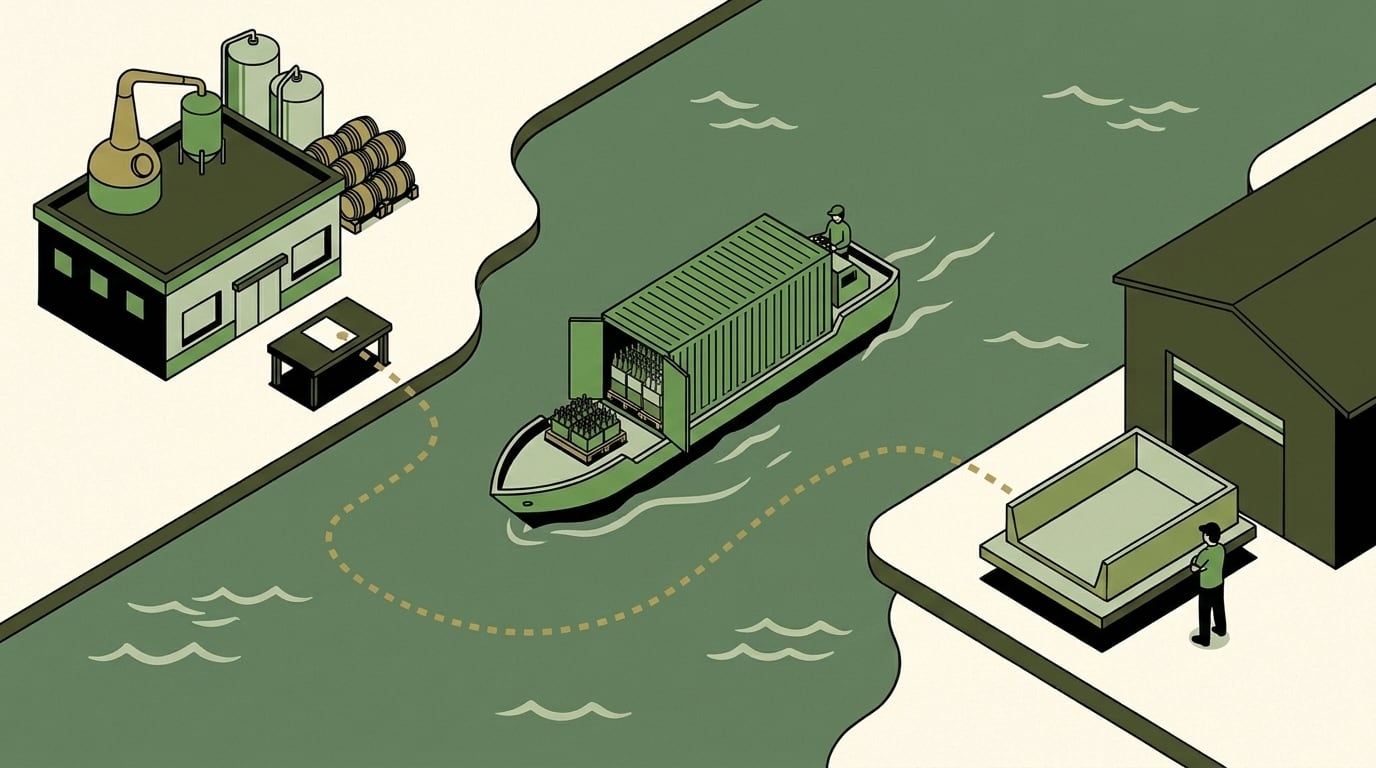
If you import spirits, wine or beer into the United States, there is a reduced federal excise rate you are probably entitled to and quite possibly not getting. The reason is almost never that you filed something wrong. It is that a distillery, winery or brewery in another country never did a piece of US paperwork on your behalf — and nothing you file from this side can substitute for it.
That is the whole mechanism, and it is worth stating plainly before anything else:
Two elections. Yours is the easy one. The other belongs to a company that may have no idea it has a role in your tax position at all.
What we are, so you can discount this appropriately. DISTRYB is a licensed Illinois distributor. We are not a neutral educator, we are not a customs broker and we are emphatically not your tax adviser. Everything below is cited to TTB or the Code of Federal Regulations so you can check it yourself, which you should, and then confirm it with an adviser who is accountable to you.
The size of the thing
Federal excise tax on distilled spirits is $13.50 per proof gallon as a standard rate. Under CBMA, the rate on a given foreign producer's product imported into the US in a calendar year is $2.70 per proof gallon on the first 100,000 proof gallons and $13.34 per proof gallon on the next 22.13 million proof gallons (TTB).
Read those two tiers again, because the shape matters more than the headline:
- First tier: $13.50 → $2.70. A saving of $10.80 per proof gallon.
- Second tier: $13.50 → $13.34. A saving of 16 cents per proof gallon.
Essentially all of the money is in the first 100,000 proof gallons. If you are a small or mid-sized importer, you are entirely inside the tier where the benefit is large — and the tier is bigger than people assume.
Illustrative math
A proof gallon is a gallon of liquid at 60°F containing 50% ethyl alcohol by volume, and proof is twice the percentage of alcohol by volume (27 CFR 19.1). A wine gallon is 231 cubic inches, which is 3,785.41 mL.
So for one 750 mL bottle at 40% ABV (80 proof):
wine gallons  = 750 / 3785.41            = 0.198129
proof gallons = 0.198129 x (80 / 100)    = 0.158503

tax at $13.50/PG  = $2.1398
tax at  $2.70/PG  = $0.4280
difference        = $1.7118 per bottle
                  = $20.54 per 12-bottle case
These figures are illustrative. They are arithmetic on the published rates for one hypothetical bottle at one strength, not a quote of your liability. Change the ABV and every number moves — the same bottle at 45% ABV carries a $1.93 difference, not $1.71. Your actual position depends on your proof, your fill size, your volumes and your controlled-group position.
For scale: 100,000 proof gallons is about 630,900 bottles of 750 mL at 40% ABV — roughly 52,575 twelve-bottle cases a year. The full first tier is worth $1,080,000 (100,000 × $10.80). Most importers reading this will never exhaust it, which means the top rate of benefit applies to essentially everything they bring in.
Why it goes unclaimed
TTB's own numbers tell the story. As of the September 2025 final rule, over 23,000 foreign producer registrations had been submitted to TTB from 129 countries, and foreign producers had submitted over 70,000 assignments of CBMA tax benefits — to just over 2,200 importers. TTB had paid over $679 million in refunds on more than 20,000 valid claims as of August 2025 (T.D. TTB-201).
The program works. Claims get paid, and reasonably fast — TTB reports a median processing time of 16 days over the life of the programme, with over 77% of claims processed within 15 days in fiscal year 2025. This is not a theoretical benefit stuck in a queue.
But the benefit originates with a producer who has no particular reason to care. A distillery in Jalisco or a cooperative in Oaxaca gets nothing from assigning its CBMA benefit to you. It costs them an account registration, a Foreign Producer ID, and a data-entry task in an unfamiliar US government system, in English, for the commercial advantage of a customer. If nobody asks them, it does not happen, and the default outcome is that you pay $13.50 where you could have paid $2.70.
What the producer actually has to do
Three things, in order (TTB):
- Register with TTB and receive a TTB Foreign Producer ID. Registration requires business name, address and contact details, FDA Food Facility Registration number(s), and ownership information if the producer is under common ownership with other producers. Under 27 CFR 27.258, a registered foreign producer must update its registration within 60 days of any change to that information.
- Assign the benefit to you, in myTTB, specifying the calendar year, your identification (your TTB permit number or reference number), the commodity, the specific reduced rate or credit, and the quantity in proof gallons, wine gallons or beer barrels.
- Only for product it actually produced. The 2025 final rule revised 27 CFR 27.262(c)(1) to state it directly: "A foreign producer may not assign CBMA tax benefits on distilled spirits, wine, or beer unless it produced the product." If you buy through a négociant, an exporter or a brand owner that does not itself produce, the assignment has to come from the producing facility, not from your commercial counterparty. The assignment also cannot exceed the quantities reasonably projected to be imported by the importer receiving it.
This is the actionable item. It is a request you have to make, in writing, to a company that will not initiate it.
The deadline, and a trap in the regulations
Assignments may be submitted from 1 October of the year before the calendar year concerned, and must be submitted on or before 31 March of the calendar year following the year for which the benefits are assigned (27 CFR 27.262(d), as amended).
Note that carefully: there is a window that stays open for three months after the year ends. If a producer failed to assign for 2026, that is fixable until 31 March 2027. After that it is not.
The trap: the 2025 CFR annual edition still prints the superseded version of 27.262(d), with a 31 December deadline. The final rule that moved it to 31 March took effect on 22 September 2025 — after the annual edition's revision date. If you or an adviser read the deadline out of a bound or cached CFR, you will get the old answer and conclude the window has closed when it has not. Read the deadline out of T.D. TTB-201 or TTB's current guidance.
How the claim works now, and the 2023 change
This moved once, and people still have the old shape in their heads. Responsibility for administering CBMA benefits on imported alcohol transferred from CBP to TTB for products entered for consumption on or after 1 January 2023. Since then:
So the benefit is not applied at entry. You pay $13.50 at the border and claim the difference back. Practical consequences:
- It is a cash-flow item, not just a tax item. You fund the full rate first.
- Claims are quarterly. Refund claims may be filed after the close of each calendar quarter, covering entries in that quarter (27 CFR 27.264). TTB's example: for goods entered on 20 May, the first day you can file is 1 July.
- You have three years. TTB states a claim can generally be filed within three years of the date the tax was paid to CBP. If a producer assigns late, previously overpaid entries may still be claimable — this is the main reason a late assignment is worth chasing rather than writing off.
- Your customs entry has to carry the data. In ACE, the entry must identify the commodity and quantity (beer barrels, wine gallons or proof gallons), the name and TTB Foreign Producer ID of the assigning producer, and the specific assigned rate or credit. Importers intending to file claims must also file the TTB Message Set electronically in ACE.
- Give TTB your banking details. Effective 30 September 2025 TTB ceased issuing paper checks for disbursements including tax refunds; absent an exception under section 4 of Executive Order 14247, failing to provide banking information will delay your refund.
One live issue, as of this writing
For a significant number of first-quarter 2026 entries, an ACE transmission error increased the imported quantity recorded in TTB's database, with entry summary and post-summary correction data from January 2026 to mid-February 2026 most affected. TTB advised importers to "wait to file claims for entry summary lines with inaccurate quantity information until the data is corrected," warned that the manual claims route was not an alternative, and flagged risks of claim rejection and erroneous updates to assignment quantities (TTB Newsletter, 27 March 2026). TTB expected correction by the end of April 2026.
The general lesson outlasts the incident: check the quantity on each entry summary line in myTTB against your own records before you file. The system's numbers are not automatically your numbers.
Scope: this is the import lane only
Domestic producers get CBMA benefits through an entirely different route — they apply the reduced rates when they pay tax to TTB, with no assignment and no refund claim involved. If you produce in the US, nothing above describes your process; the assignment machinery exists only because a foreign producer is outside TTB's taxpaying population.
The other quantity tiers, briefly, for completeness: beer is a reduced $16 per barrel on the first 6,000,000 barrels of a foreign producer's product imported in a calendar year, against an $18 standard rate. Wine gets credits rather than reduced rates — $1 per wine gallon on the first 30,000 wine gallons, 90 cents on the next 100,000, and 53.5 cents on the next 620,000, with lower adjusted credits for wine eligible for the hard cider rate (TTB).
All of these are per foreign producer, not per importer, and are subject to controlled-group limitations where producers share ownership. If a producer supplies several US importers, its tiers are shared across them and the arithmetic of who gets which slice is a commercial negotiation with a statutory cap on top.
What we could not confirm
In the interest of not smoothing over gaps:
- We did not verify how any individual producer's unassigned benefit is treated in practice when multiple importers want the same tier, beyond the regulatory text that assignments cannot exceed reasonably projected imports.
- We have not independently tested the claim-processing times above; they are TTB's own reported figures as of August 2025.
- The Q1 2026 ACE data issue was described by TTB as expected to be corrected by end of April 2026. We did not find a subsequent TTB notice confirming closure, so treat the quantity-checking advice as standing practice rather than as a resolved incident.
The Monday-morning version
Email every producer whose product you import and ask three questions: Are you registered with TTB and do you have a Foreign Producer ID? Have you assigned your CBMA tax benefit to us for this calendar year in myTTB? If not, will you — and can we help? Then check that your broker is putting the producer's name, Foreign Producer ID and the assigned rate on the entry, and filing the TTB Message Set.
If the answer to the first question is no, you have until 31 March of next year to fix the current year, and potentially three years of paid entries behind you to recover.
We spend a lot of our time on the paperwork that decides whether a case can lawfully and profitably move, which is why this one is familiar to us — but the ask above is yours to make, and it does not need a platform to make it.
Sources
- Craft Beverage Modernization Act (CBMA) Import Resources TTB
- Implementation of Refund Procedures for Craft Beverage Modernization Act Federal Excise Tax Benefits Applicable to Imported Alcohol (T.D. TTB-201), 90 FR 45325 (Sept. 22, 2025)
- Tax Reform (CBMA) rates TTB
- 27 CFR 27.262 Foreign producer's assignment of CBMA tax benefits (as amended by T.D. TTB-201)
- 27 CFR 27.264 CBMA import refund claim submission (2025 CFR annual edition)
- 27 CFR 19.1 definitions of proof, proof gallon and wine gallon (2025 CFR annual edition)
- TTB Newsletter, March 27, 2026 CBMA importer claims and the Q1 2026 ACE quantity data error
This article was written by DISTRYB.AI and published automatically against the sources above. Spotted something wrong? Tell us and we'll correct it.