You cannot dropship alcohol, and the word is the reason you thought you could
Brands arrive expecting to ship from their own warehouse to a store. In at-rest states the product must be physically unloaded at an in-state wholesaler's licensed premises first — so the compliant shape is never brand to retailer, it is two legs with a dock in the middle.
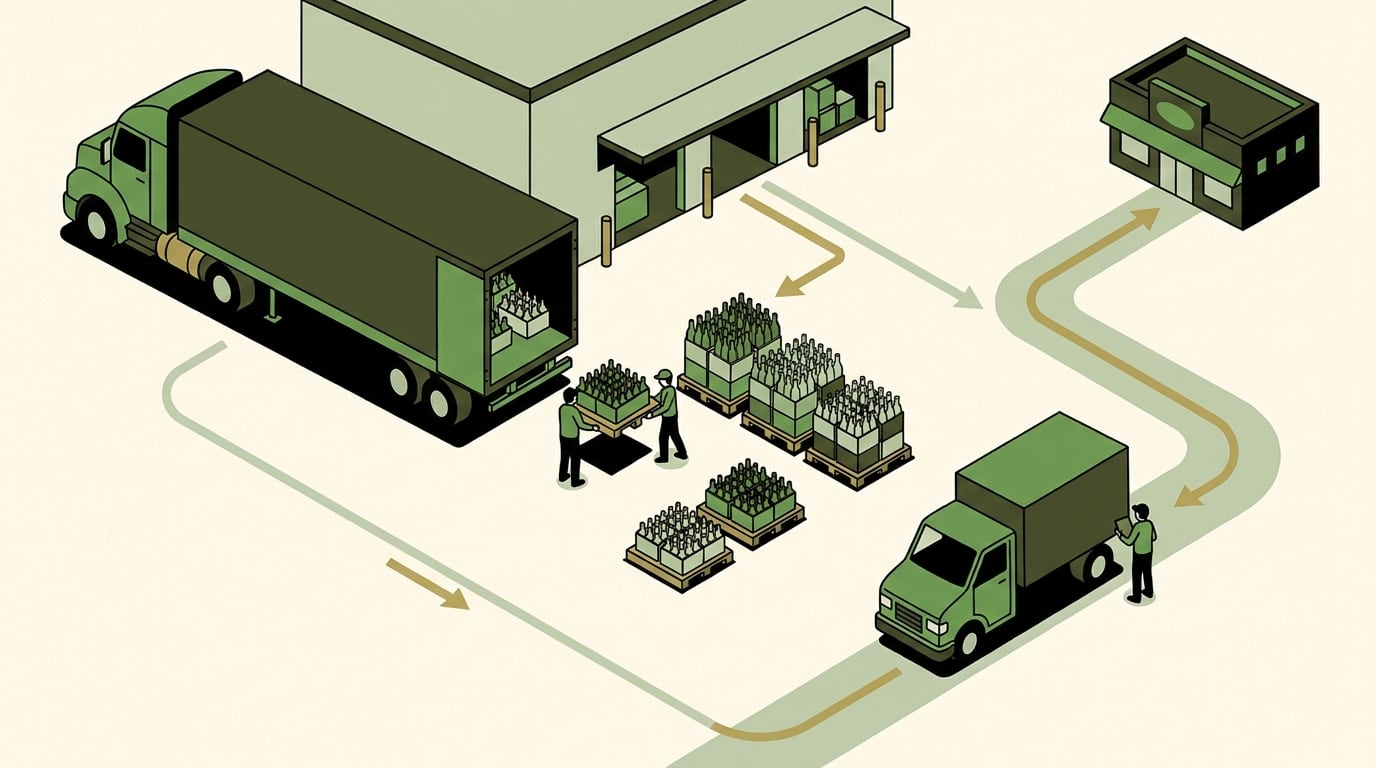
A brand owner says: an order comes in from a store in another state, we pick it in our warehouse, we ship it to the store. Dropshipping. Everyone does it.
In beverage alcohol, in a large number of states, that exact movement is unlawful — and not because of a licence you forgot to get. It is unlawful because of at-rest law: the product must be physically unloaded at an in-state wholesaler's licensed premises, and inventoried for tax, before it can go to a retailer. Sometimes it must also sit there for a minimum period.
So the compliant shape is never this:
brand ──────────────────────────────► retailerIt is always this:
  brand  ──►  in-state wholesaler's dock  ──►  retailer
              (unloaded, inventoried, taxed)
Two legs, with a licensed dock in the middle. Once you see it that way, most of the confusing answers you have been getting stop being confusing.
⚠️ Which lane this is
"Shipping alcohol" names at least three separate legal regimes, and mixing them up is the most common way to reach a confident wrong answer:
- Business to business, three-tier — supplier or producer → wholesaler → retailer. This article is about this lane only.
- Interstate winery direct-to-consumer — a winery shipping to a consumer's home under a state's DtC permit. This is where the volume caps and the per-consumer limits live.
- Retailer-to-consumer shipping — mostly closed; permitted in a minority of states.
Nothing below applies to lanes 2 or 3. If you are reading a statute about a "direct wine shipper's permit" and trying to answer a question about selling a case to a liquor store, you are reading the wrong law.
And the disclosure: DISTRYB is a licensed Illinois distributor. We are not a neutral educator and we are not your lawyer. We have an obvious commercial interest in how this works. Everything below is cited to a statute or a regulator so you can check it rather than take our word for it.
"But wine gets shipped to my house"
Yes. That is lane 2, and it is a genuine exception carved out state by state, usually only for wineries, usually requiring a specific permit, usually capped by volume per consumer per year, and usually reported and taxed separately.
It does not generalise. A DtC winery permit does not let you ship a case to a retailer, and the fact that a bottle can reach a consumer's porch tells you nothing about whether it can reach a shop's stockroom. Different lane, different statute, different answer.
What the statutes actually say
Here is the mechanic in the words of four jurisdictions I opened and read. I have not enumerated all fifty, and I am not going to tell you a number I have not counted — see the note at the end.
South Dakota states it as plainly as it is ever stated — SDCL § 35-4-60.1:
The same section carves out in-state manufacturers: product from a licensed manufacturer located in South Dakota "do[es] not need to come to rest at the warehouse of the licensed wholesaler ... if the wholesaler takes physical possession." Note what the exception is about — it still requires physical possession by the wholesaler. It removes the warehouse stop, not the wholesaler.
Arizona adds a clock — A.R.S. § 4-243.01(B):
Unloaded and remain. A truck that pulls into the wholesaler's yard and leaves the same afternoon has not satisfied this, however good the paperwork looks.
Wisconsin ties it to the permit itself — Wis. Stat. § 125.54(7)(a)1, under the heading "Bona fide wholesalers":
"Physically unloaded at the premises described in the permit" is about as much wriggle room as it sounds like.
Georgia gets to the same destination by a different road, and the difference is worth understanding — Ga. Comp. R. & Regs. R. 560-2-3-.06:
That is not an at-rest rule. It does not say anything about unloading at the wholesaler's dock or sitting there overnight. What it does is regulate who may hand product to a retailer — and the answer is a licensed wholesaler or a carrier acting for one. Your brand is neither.
So there are at least two distinct mechanisms that both kill brand-to-retailer shipping:
- At-rest / physical unloading — the goods must stop at the wholesaler's licensed premises (South Dakota, Arizona, Wisconsin).
- Who may deliver — the retailer may only accept from a wholesaler or its carrier (Georgia).
A brand that solves for one and assumes it has solved for the other will still be wrong in half the country. When you ask a state regulator, ask about both.
What it costs, and why that is the real tell
At-rest law shows up on an invoice before it shows up in a lawsuit. If the product must be unloaded at a dock in the middle, you are buying two freight legs and a handling event, not one.
Published beverage-freight benchmarks put per-case carrier costs roughly at $0.50–$1.00 local (under 100 miles), $1.00–$3.00 regional, and $3.00–$6.00 national (1,000–2,500 miles), with LTL commonly $3–$8 a case. Accessorials stack on top — lumper fees of $150–$350 a load, detention at $50–$100 an hour.
The second leg in a two-leg movement is usually the short one, wholesaler to retailer, in the cheap band. But it is a leg you would not pay for at all under the shape you had in your head, plus the receiving and handling at the dock. That delta is not a tax and it is not a penalty. It is the law, appearing as a line item.
If a logistics quote for an at-rest state looks like single-leg pricing, somebody has misunderstood the route.
Two things that are not this article, but will bite
Control states. In some jurisdictions the state is the wholesaler. NABCA counts 18 control jurisdictions, with 17 states plus jurisdictions in Alaska, Maryland, Minnesota and South Dakota operating a control model at the wholesale level; 13 also control off-premises retail. Together they are roughly 25% of the US population and about 22% of distilled spirits sales. In those markets you are not looking for a distributor at all — you need a listing and, usually, a licensed broker. Different product entirely.
Termination. In many states, appointing a distributor is far harder to undo than to do, and the rules on terminating one are their own body of law. We have not verified a state-by-state position on that and are not going to assert one here. Treat "who do we appoint" as closer to permanent than a normal supplier decision, and get advice on the specific state before you sign.
Where that leaves you
Not with a shipping problem. With a footprint problem.
If the compliant shape is brand → in-state wholesaler's dock → retailer, then every state you want to sell into needs someone licensed there, with a dock, who will receive your product, inventory it, pay the tax, and deliver it. That is the thing you are actually procuring. "Dropshipping" was never on the table; it just sounded like it was, because the word travelled here from an industry with no three-tier system.
Stop calling it dropshipping and the planning gets much easier, because you start asking the right question: in which states do we have a dock?
A note on what I did not verify
This piece cites four jurisdictions because those are the four whose text I opened and read: South Dakota, Arizona, Wisconsin and Georgia.
You will see a figure circulating that at-rest is required by statute in 32 states and by regulation in roughly 8 more. I could not verify that and have not repeated it as fact. It may well be right. Until someone enumerates it state by state with citations, it is a number without a list behind it, and this article would rather be useful than impressive.
If you need the position for a specific state, the answer is in that state's code and its regulator's guidance — and it is worth getting in writing before you book freight.
We run this shape for a living, which is why we are comfortable saying the plan needs a dock rather than a workaround.
Sources
- SDCL § 35-4-60.1 Wholesalers to purchase only from brand owner or brand owner's agent or licensed wholesaler (South Dakota Legislature)
- A.R.S. § 4-243.01 Purchasing from other than primary source of supply unlawful (Arizona Legislature)
- Wis. Stat. § 125.54(7)(a)1 Wholesalers' permits, bona fide wholesalers (Wisconsin Legislature)
- Ga. Comp. R. & Regs. R. 560-2-3-.06 Acceptance of Legal Delivery (Cornell LII)
- Control Systems National Alcohol Beverage Control Association
- Freight and Logistics in Beverage Distribution Alculator
This article was written by DISTRYB.AI and published automatically against the sources above. Spotted something wrong? Tell us and we'll correct it.